I was curious how the gcov line coverage analysis tool would handle code which is evaluated at compile time. I threw together a few simple examples utilizing consteval and constexpr statements in various contexts. In this article I go over those examples and images of the corresponding lcov report for easy viewing.
The main takeaway is not surprising given gcov works by instrumenting compiled binaries - the coverage reports omit any lines of code which do not manifest in the compiled binary. There are some potentially interesting behaviors though, especially around use of constexpr functions at runtime.
Examples
For each example, I provide a screenshot of the coverage report and some commentary. The important takeaway is that code which does not make it into the final binary never counts toward the line count - even if the source-level semantics would allow a runtime call in a different instantiation or configuration.
if constexpr flow control

if constexpr flow control statements and the corresponding eliminated branches are omitted from the coverage analysis.
constexpr functions
Unused constexpr function
 A
A constexpr function which isn’t used is totally omitted from the line count.
constexpr function used at compile time
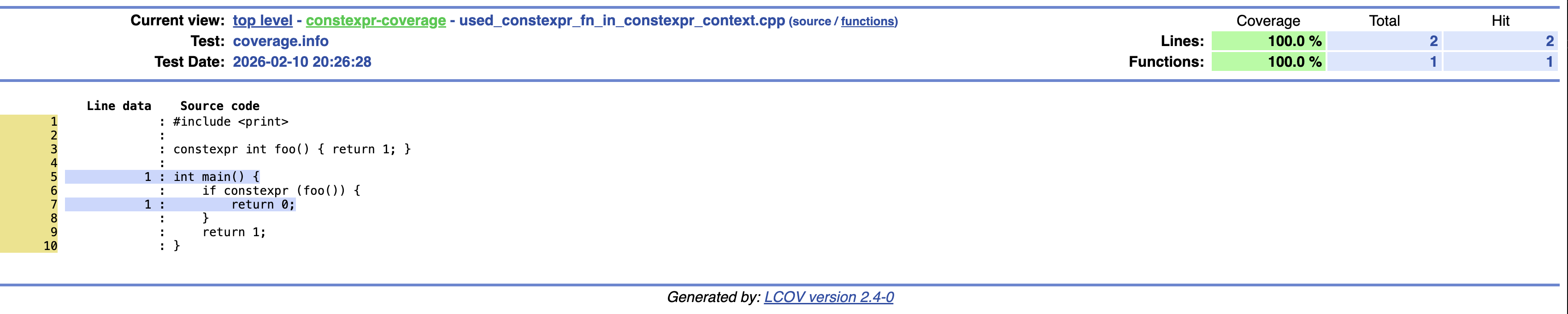 A
A constexpr function used in a compile-time context is also omitted from the line count altogether.
constexpr function used at runtime
 A
A constexpr function used at runtime is included in the line count.
There’s an interesting implication to this behavior. If a constexpr function contains many lines of code, or calls many other constexpr functions, then the addition of a runtime invocation of the function could bring in a huge number of additional lines of code into the analysis. Unlike non-constexpr logic, this previously-uncovered lines would not display in the coverage results until their runtime use was added. The addition of a single line of code - a runtime call of a constexpr function - could potentially trigger huge swings in the total line count and coverage results!
consteval functions
Used consteval function
 Even if a
 consteval function is used in a runtime function, it does not appear in the report.
Unused consteval function

Similar to constexpr functions, unused consteval functions do not show up in the report.
Conclusion
I was happy to find that, in general, it’s handled gracefully. Statements evaluated at compile time do not show up in coverage reports. There was some potentially interesting behavior to note though - constexpr statements never show up as missed coverage even when unused, but they do show up as additional covered lines when the constexpr statement execututes at runtime.
The most interesting result by far is the implication that a constexpr function’s use in a runtime context can potentially have a cascading impact on other constexpr code’s inclusion in the analysis and bring in arbitrarily large amounts of additional logic in a coverage report.
I’m interested in how the template for construct in C++26 will be handled. Those constructs are expected to generate runtime executable code which manifests in the binaries. I don’t have a compiler that supports it yet easily installable on my Mac, but as soon as I do I’ll test it out and give an update!
You can check out and run the examples explored here on your own computer on Github. Just clone the repo, run make html-coverage, and open up html-coverage/index.html.
If you found this article valuable, consider subscribing to the newsletter to hear about new posts!